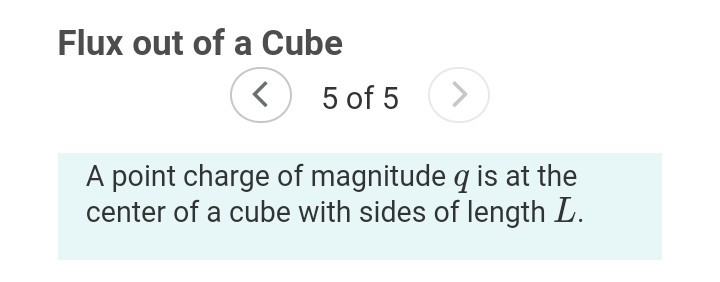
Flux Out Of A Cube Mastering Physics. I then plugged in z. The flux into one side of the cube is exactly canceled by the flux out of the opposite side.
Solved Flux Out Of A Cube 5 Of 5> A Point Charge Of Magni from www.chegg.com
The net contains no net charge. A hollow cube with a point charge + q at the center of one of the faces. What is the electric fluxe φ1 through side 1?express your answer using two significant figures.
What's The Total Flux Through Any Closed Surface That Surrounds A Charge Q?
Summing the result in part (a) φ t o t, e = 0. Once you find the total flux, then use symmetry to find the. Print and answer unlike what queueoverflow says, you don't actually need to do any integration here;
A Very Cool Argument Will Give You The Answer.
Gauss's law relates the electric flux through a closed surface to the total charge enclosed by the surface:. Flux through a cube mastering physics luxurious, conductor, cube, redius, gaussian, magnitude, quantity, density, external, spherical, www.physics.rutgers.edu mastering physics: The flux into one side of the cube is exactly canceled by the flux out of the opposite side.
If The Charge Is Outside The Cube, The Flux Through Each Face Will Be Nonzero, But Now The Total Flux Will Be Zero.
E e = 1 4 π ϵ 0 e | r − r ′ | 3 ( r − r ′) = e 4 π ϵ 0 ( x − x ′) x ^ + ( y − y ′) y ^ + ( z − z ′) z ^ [ ( x − x ′) 2 + ( y − y ′) 2 + ( z − z ′) 2] 3 / 2. The flux depends only on the total enclosed charge. I understand how i would find the charge with the flux with gauss's law, but not how to get the flux itself.
The Net Contains No Net Charge.
The sides of the cube are parallel to the coordinate planes. (c) the electron was placed at, r ′ = − 2 a x ^ + a 2 y ^ + a 2 z ^. Homework statement what is the flux of vector field f = xi + zj out of the cube that has corners in (0,0,0),(1,0,0),(0,1,0),(0,0,1),(1,1,0),(1,0,1),(0,1,1),(1,1,1).
A Hollow Cube With A Point Charge + Q At The Center Of One Of The Faces.
I set up the surface s: The attempt at a solution. The shape of the surface enclosing a charge, in this case a cube, does not affect the total electric flux through the surface.